Tomorrow, you can buy it. Starting May 1st, the LEGO sets at the centre of the most-watched football campaign in recent memory go on sale globally — and if you haven’t seen the ad yet, you’ve been offline.
View this post on Instagram
The table is dimly lit. Four men are gathered around it. At the centre, a brick-built version of the FIFA World Cup trophy rotates slowly. One by one, Lionel Messi, Cristiano Ronaldo, Kylian Mbappé and Vinícius Júnior reach forward to place their personalised LEGO minifigure on top — each trying to claim the summit. None of them succeeds. A young boy walks in, places his own figure on the trophy, and the four greatest footballers on the planet step back.
The campaign landed across the combined Instagram accounts of all four players to the tune of 314 million views, with one fan capturing the room’s energy precisely: “This might be the most expensive group chat ever assembled.” What nobody said immediately, and what a behind-the-scenes video confirmed days after launch, was that they were never in the same room. Body doubles handled the blocking and lighting tests. Green screen and CGI stitched all four players into a single unified shot — each filmed separately, their likenesses real, their proximity invented. Messi posted the campaign to his Instagram with the hashtag #HonestlyItsNotAI. Technically correct. The players are genuine. The shared moment was built in post-production.
It is the same technique used for the Louis Vuitton chess campaign before Qatar 2022 — Messi and Ronaldo photographed in different locations, composited into the same frame. The behind-the-scenes footage from that shoot only surfaced later. Nobody liked the image less. It became one of the most liked posts in Instagram history regardless. The illusion held not because it fooled anyone but because it pointed at something true — two men, one rivalry, one trophy, one question about who the greatest was. The image answered it without needing them in the same room to do so.
LEGO’s campaign is doing the same thing at a larger scale and with a more complicated question.
Messi will be 39 when the World Cup opens in June. Ronaldo will be 41. Both confirmed for their sixth tournament — an unprecedented milestone, but neither arrives carrying the same weight of destiny as Qatar. Messi has his winner’s medal, earned in the greatest final ever played. Ronaldo has declared 2026 his last major international outing, still chasing the one trophy that has always been just beyond him. This is a closing chapter. The question is not whether they were the greatest of their generation. That conversation is settled. The question is what the sport looks like when they are finally gone.
Mbappé scored a hat-trick in the 2022 final against Argentina — a performance so complete it could have won any other final in World Cup history, and still went home without the trophy. He is 27. He has at least two more tournaments ahead. Vinicius Júnior spent three seasons establishing himself as the most exciting winger on the planet, won the Ballon d’Or in 2024, and has dragged Brazil back into serious contention after years of underperformance. He is 25. The era that is ending created both of them. The campaign puts all four at the same table because that is the actual state of the sport right now — an ending and a beginning occupying the same frame, neither one quite finished yet.
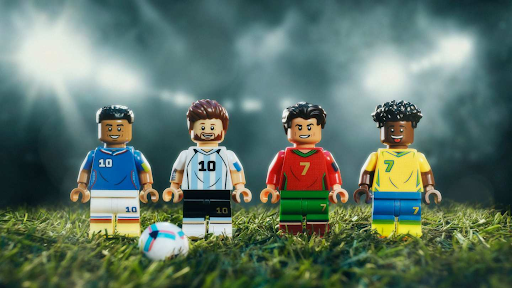
Securing four individual endorsement deals across players from different countries, different clubs, different commercial ecosystems — Messi at Inter Miami, Ronaldo at Al-Nassr, Mbappé and Vini Jr. at Real Madrid, under a single FIFA-licensed campaign — is something most brands would not attempt. Our LEGO Agency and Wieden & Kennedy Amsterdam built the whole thing anyway. Now the sets are here. They run from $29.99 Football Highlights builds for 10-year-olds to a $199 Messi Celebration wall art — 1,427 pieces, display-ready, aimed at the adult who has followed these players for fifteen years and wants something that outlasts the tournament. Not merchandise. Memorabilia. A signed shirt expires. A well-made collectable sits on a shelf for decades and appreciates. LEGO understood that before anyone else did.
The boy at the end of the video is the most deliberately constructed image in the campaign. He does not represent the next Messi or the next Ronaldo. He represents everyone who has never been on a professional pitch and never will be, and who has a claim on the game regardless. LEGO has spent nearly ninety years understanding that the person who builds a thing cares about it differently from the person who watches it. That insight is the whole campaign.
The composite reveal did not damage it. It extended it — a second wave of conversation, people debating what was real, what was constructed, what it means that the image felt true even after the mechanics were exposed. Which is the more interesting question anyway? Not whether they were in the same room. But why did it matter that we believed they were? What that belief was doing for us.
The sets go on sale May 1st. The World Cup starts June 11th. The question of who the game belongs to has already been answered.