

Exploring the work and influence of one of the 1980s’ most important artists, who reshaped how Black bodies, queerness, and African identity are seen through the lens.
In a career cut painfully short, Rotimi Fani-Kayode’s legacy did not rest in volume or longevity, but in rupture, as he produced a body of work that permanently altered how Black bodies, African spirituality, and diasporic identity could exist within the photographic frame.
Born in Lagos in 1955 and forced to flee to Britain with his family following Nigeria’s civil war, Rotimi Fani-Kayode lived between worlds. That displacement became the foundation of his visual language. After studying in the United States, he worked primarily in London.
Rejecting both Western exoticism and narrow definitions of African tradition and sexuality. His photographs fused ritual, eroticism, and performance into something confrontational and deeply self-possessed.

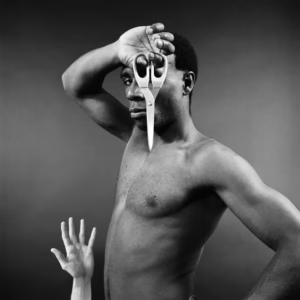
At the core of his work was a radical reclaiming of the Black body. His subjects were active, commanding, and fully aware of their power, and by centering Black male bodies—often queer, often masked, often engaged in ritual—Fani-Kayode dismantled centuries of imagery shaped by colonial voyeurism. He replaced it with images authored from within, where desire and spirituality were inseparable.




Crucially, Fani-Kayode refused to separate identity into neat categories. Sexuality, race, religion, and myth coexisted in his work. This refusal unsettled audiences across cultural lines: Western institutions uncomfortable with Black autonomy, and African audiences resistant to confronting queerness within their own spiritual frameworks. That tension is precisely where his work lives—and why it endures.
Though he died in 1989 at just 34, after a brief career of six years, Fani-Kayode’s influence and visual grammar can still be traced across contemporary photography, fashion, and art practices today.
The political and social commentary of Rotimi Fani-Kayode’s legacy is not simply that he made space for new representations—it is that to be seen is not enough; one must also define the terms of that visibility.


